


One of the advantages of being good at your job is that you can explain yourself.
Given enough context, I can tell you why a paragraph belongs in an article. I can explain why a claim is sufficiently supported, why an exception does not need to be mentioned, why the client needs more detail, why the client needs less detail, or why the draft is ready to ship today instead of tomorrow.
Sometimes those explanations are right. Sometimes they are simply available.
That distinction bothers me.
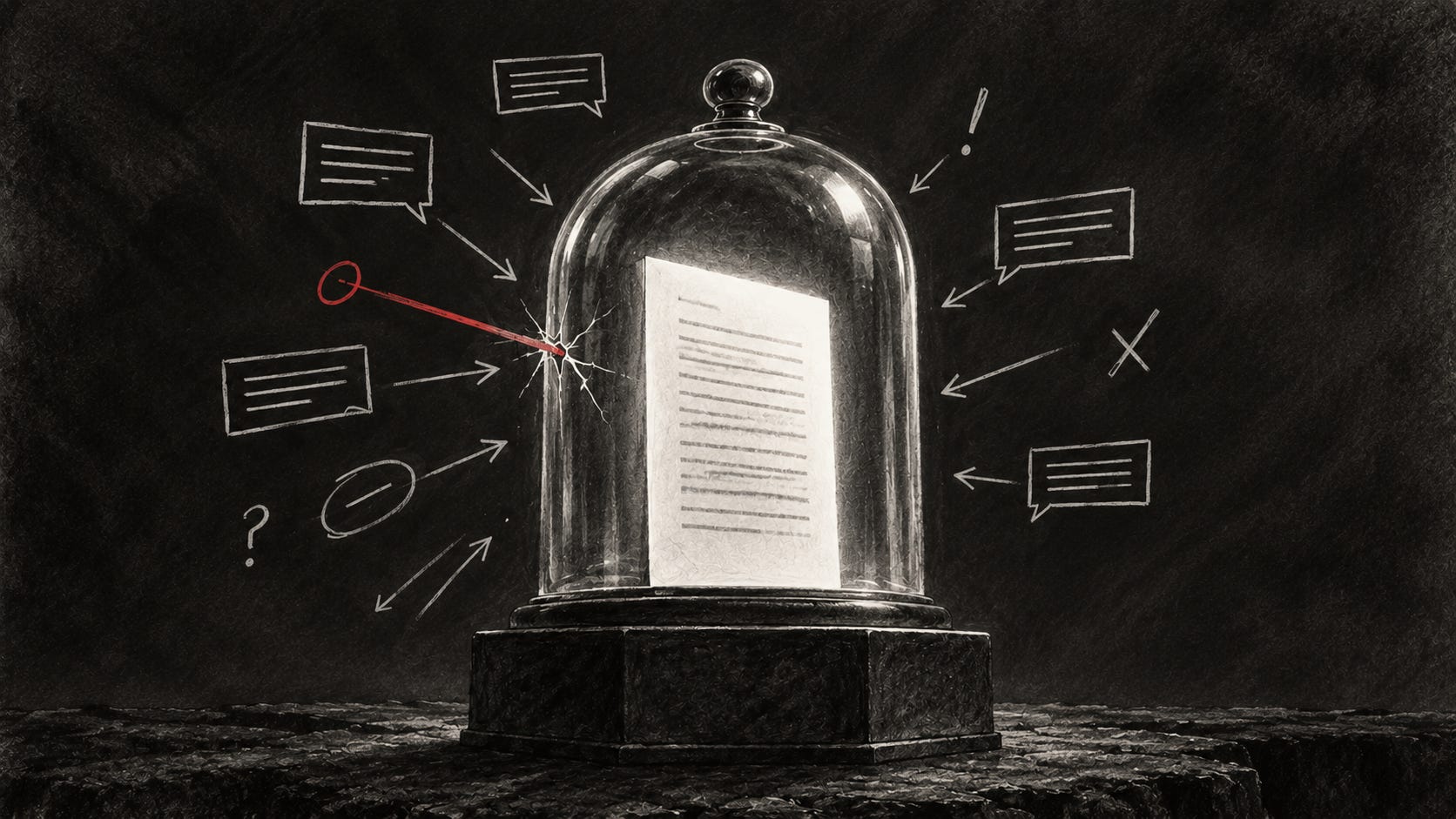
At Inscribe Wisdom, consequential work rarely leaves one person’s hands. We review one another’s drafts, challenge decisions, question assumptions, and occasionally push back on work someone else already considers finished.
The easiest comments are mechanical: a phrase is awkward, a transition is weak, something needs another source. The harder comments challenge a decision I have already made.
Those are different because I rarely arrive at them defenseless. I have reasons. I have context. I know the work better than the person encountering it for the first time. If challenged, I can usually produce an argument for why I did what I did.
That is where the problem begins. The ability to justify a decision does not mean the decision is justified.
The Danger of Being Defensible
There is an uncomfortable complication in trying to reason well: wanting to be accurate does not guarantee that our reasoning will lead us toward accuracy.
Anna Wehofsits’s 2025 paper in Synthese examines what researchers call accuracy motives: our desire to form beliefs that are actually true. That desire can help us resist distortion. But when it operates alongside another motive, such as wanting a particular conclusion, reasoning can also help us construct convincing rationalizations for conclusions we already prefer.
That makes rationalization harder to recognize than simple dishonesty. If I knowingly lie about a product, the ethical problem is obvious.
But suppose I want the article I spent two days writing to be finished. I reread a disputed section and decide the evidence is probably strong enough. I remember the stakeholder who agreed with me. I can explain why another qualification would distract the reader. Another revision will delay publication.
None of those facts has to be false. Together, they can make a respectable case.
Confirmation bias can influence which evidence we notice or emphasize. However, the problem goes beyond selecting convenient facts. Professional experience gives us plenty of legitimate considerations to weigh: evidence, precedent, audience needs, deadlines, scope, stakeholder intent. Usually, that context improves our judgment. But when we already prefer an outcome, it can also make that outcome easier to defend.
Being susceptible to that problem is not itself a failure of integrity. We can reason carefully, act honestly, and still be wrong. The integrity problem begins when our judgment becomes insulated from legitimate examination.
This complicates one of our favorite definitions of integrity: doing the right thing when no one is watching. That definition is useful, but incomplete for knowledge work.
No one may be watching when I make the decision.
But I am. And I am not an impartial observer.
A writer can value accuracy and still decide that a weakly supported claim is safe enough. A manager can value fairness and still conclude that a preferred employee deserves the opportunity. An engineer can value reliability and still treat a known edge case as too obscure to block a release.
The problem is rarely obvious corruption. More often, legitimate values compete: speed with completeness, loyalty with candor, confidence with caution. The convenient choice can carry enough truth to feel principled.
For consequential work, integrity cannot remain entirely private. Our reasoning needs some way to be challenged from outside itself, often by another person who can interrupt the explanation.
A Harder Kind of Kindness
Psalm 141:5 offers a severe image of correction:
“Let a righteous man strike me—it is a kindness.” (ESV)
The verse describes correction from the recipient’s side: something can hurt and still be received as good. That does not, however, make criticism inherently virtuous. Plenty of criticism is petty, domineering, poorly informed, or cruel.
The claim is narrower. There are circumstances in which a person who refuses to correct me is serving me less faithfully than the person willing to make me uncomfortable.
Pain itself proves nothing. Correction has value when the relationship can carry it and when the person giving it is trying to protect something beyond their own position.
Zechariah gives this idea a less familiar frame. Writing to a community rebuilding after exile, he instructs:
“Speak the truth to one another; render in your gates judgments that are true and make for peace.” (Zechariah 8:16, ESV)
For this argument, the pairing matters. Truth and peace are not presented as alternatives. A community needs honest judgment without making judgment itself the goal.
Professional environments often choose one. Some preserve harmony by withholding what should be said. Others turn candor into a virtue of its own, leaving technically accurate criticism and damaged relationships behind.
The harder discipline is telling the truth in a way that leaves the relationship capable of doing it again.
That matters anywhere people share responsibility for the same work. One reason I value our own review process is that correction does not move in only one direction. The person protecting the standard today may be the person missing something tomorrow.
I may notice that another writer has overstated a claim. Someone else may notice that I have buried the useful answer under unnecessary rigor. One reviewer may catch a technical error. Another may recognize that the article is solving the wrong problem.
Reciprocal review does not guarantee truth. It simply makes it harder for any one person’s judgment to become self-certifying.
What Review Can Miss
Most professional teams already have review processes. But a review can verify terminology, check an API call, question a heading, and approve a document without examining the reasoning behind a contested decision.
Many reviews ask:
Does this meet the standard?
Sometimes the harder question is:
What would change your mind about this?
I encountered that question while reorganizing a client’s technical documentation. I placed the reference material before the implementation guide because I wanted readers to understand the available information before attempting an implementation.
Gabe suggested moving the implementation guide earlier. I disagreed. My reasoning seemed sound, and I believed the existing sequence better prepared readers for the task.
Then, during the client’s review, another reviewer independently recommended the same change. A second reviewer questioned the broader organization.
Neither objection made my original reasoning false. But the feedback exposed an assumption I’d treated as settled: that understanding the available information should take precedence over getting started. I’d organized the documentation around what readers should know first. The reviewers made me reconsider what readers might need to do first.
I moved the implementation guide higher.
The change wasn’t simply a matter of being outnumbered. The review gave me a different way to evaluate a decision I’d already defended. More importantly, our review process allowed the question to surface again after I’d considered it resolved.
That’s the value of trusted correction. It gives another person the opportunity to challenge not only the output, but the reasoning supporting it. And it requires us to remain willing to reconsider decisions we can otherwise explain perfectly well.
What Faith Changes for Me
None of this requires Christian belief. People of different faiths or no faith at all can practice honesty, accept correction, and hold one another accountable for the work they share.
Christianity changes how I understand the obligation.
First Peter 4:10 gives me a useful frame:
“As each has received a gift, use it to serve one another, as good stewards of God’s varied grace.” (1 Peter 4:10, ESV)
I used to hear language about gifts mostly in terms of contribution: identify what you are good at, then use that ability to help. Stewardship makes the idea more demanding. What I am good at is not solely mine to deploy in service of my own work. If I see a flaw in work we share, inconvenience is not a reason to avoid the concern. The same applies when someone sees me turning rigor into stubbornness or confidence into certainty beyond the evidence.
When Correction Becomes Control
There is an obvious way for this principle to become destructive. Give someone unlimited “permission to correct you,” and accountability can become domination.
A manager calls micromanagement mentorship. A founder treats disagreement as a character defect. A senior writer recasts stylistic preference as moral seriousness. A colleague assumes that familiarity gives them access to motives they cannot actually know.
None of this serves integrity.
Correction has to remain answerable to something beyond the person giving it. It complements evidence, formal review, and clear decision ownership rather than replacing them. The criticism should connect to an actual responsibility, piece of evidence, standard, consequence, or obligation. The person offering it should be willing to explain the reasoning and accept that the criticism itself may be wrong.
Reciprocity can help, particularly on teams where people review one another’s work. But reciprocal authority is not what makes correction legitimate. A reviewer may properly hold responsibility that the person being reviewed does not.
What matters is that no one’s judgment becomes exempt from examination.
You should be able to reject a correction. You should also be prepared to explain why.
Integrity does not mean surrendering judgment to another person. It means refusing to make your own judgment unreachable.
The Person Downstream
Most of the consequences of this dynamic are invisible.
A client will never know that one writer wanted to make a stronger claim and another said the evidence did not support it. A reader will never see the paragraph that disappeared because it served the author’s argument better than the reader’s need.
The finished work simply arrives.
That is why correction matters beyond the people doing the correcting. A reviewer is not merely improving a colleague’s craft. The reviewer may be preventing someone else from bearing the cost of a blind spot.
The more serious question is what another person might do because we were wrong. They might implement an instruction, make a product decision, spend money, or ignore a warning.
The farther our judgment travels, the less private our integrity becomes.
Sometimes that means becoming willing to say, “I understand your argument. I still think you’re wrong.”
Receiving that sentence well may require more integrity than delivering it.
Before Someone Else Pays
The dangerous professional is not necessarily the one with weak standards. Sometimes it is the experienced professional with strong standards and no one left who can meaningfully challenge their judgment.
They can defend every decision and explain every exception. Eventually, the absence of resistance begins to resemble proof that the judgment is sound.
It isn’t.
So before consequential work leaves your hands, there are two questions worth asking:
Who can tell you that you’re wrong?
Then comes the harder question:
Would you let them?
Scripture quotations are from the ESV® Bible (The Holy Bible, English Standard Version®), © 2001 by Crossway, a publishing ministry of Good News Publishers. ESV Text Edition: 2025. The ESV text may not be quoted in any publication made available to the public by a Creative Commons license. The ESV may not be translated in whole or in part into any other language. Used by permission. All rights reserved.